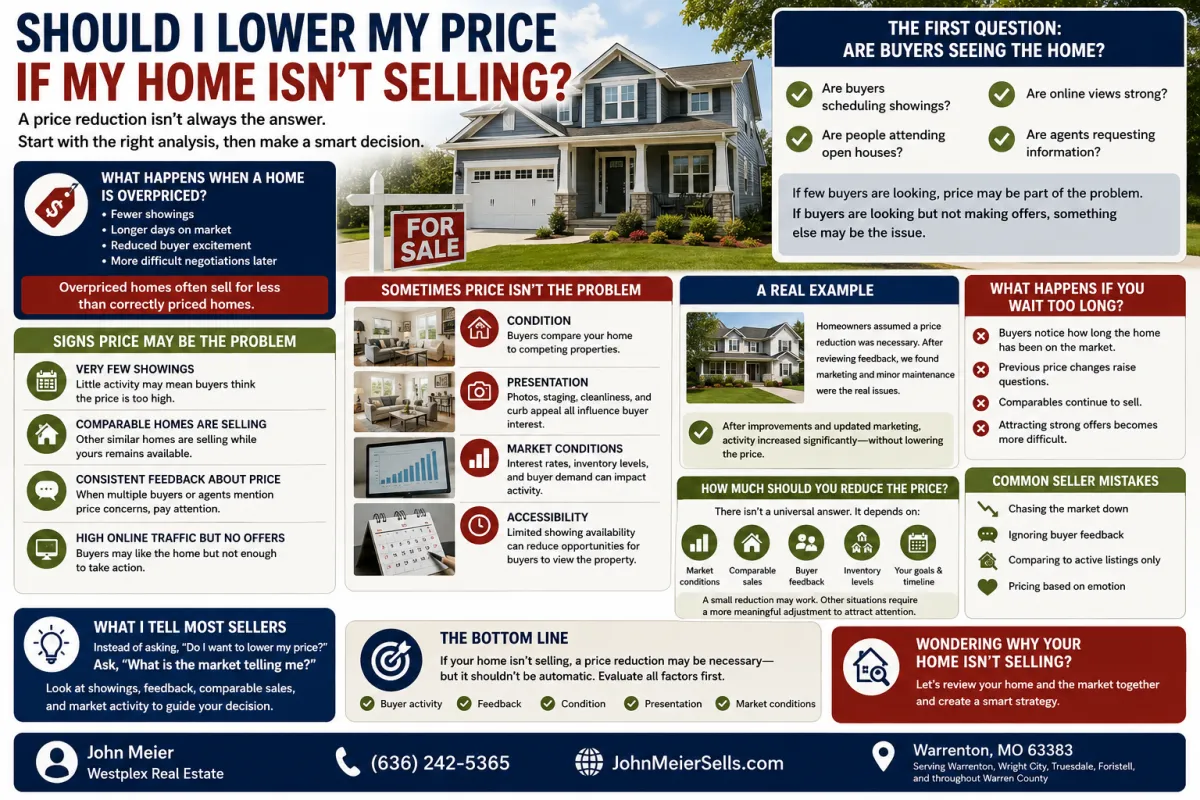
Should I Lower My Price If My Home Isn't Selling?
If your home has been on the market for a while and you're not getting the activity you expected, you're probably asking:
"Should I lower my price if my home isn't selling?"
It's one of the toughest decisions sellers face.
Nobody wants to leave money on the table.
At the same time, every day your home sits on the market can make selling more challenging.
The good news is that a price reduction isn't always the answer.
The first step is figuring out why your home isn't selling.
John Meier is a real estate agent in Warrenton, Missouri helping sellers in Warrenton, Wright City, Truesdale, Foristell, and throughout Warren County understand market conditions and make smart pricing decisions.
The First Question: Are Buyers Seeing the Home?
Before lowering the price, it's important to evaluate buyer activity.
Ask yourself:
Are buyers scheduling showings?
Are people attending open houses?
Are online views strong?
Are agents requesting information?
If very few buyers are looking at the home, pricing may be part of the problem.
If buyers are looking but not making offers, something else may be causing concern.
What Usually Happens When a Home Is Overpriced?
When a home is priced too high, buyers often don't even schedule a showing.
Instead, they move on to other homes that appear to offer more value.
This can lead to:
Fewer showings
Longer days on market
Reduced buyer excitement
More difficult negotiations later
Ironically, an overpriced home often sells for less than a correctly priced home because it loses momentum.
The Market Doesn't Care What We Need
One of the hardest realities for sellers is that buyers don't determine value based on what we need to make from the sale.
Buyers focus on:
Comparable homes
Condition
Features
Location
Competition
The market ultimately determines value through buyer behavior.
Signs Price May Be the Problem
There are several clues that pricing may need to be reconsidered.
Very Few Showings
If the listing is receiving little activity despite strong marketing, buyers may view the price as too high.
Comparable Homes Are Selling
If similar homes are selling while yours remains available, buyers may see a better value elsewhere.
Consistent Feedback About Price
When multiple buyers or agents mention price concerns, it's worth paying attention.
High Online Traffic but No Offers
Buyers may like the home enough to look but not enough to act.
Often this points to a mismatch between price and perceived value.
Sometimes Price Isn't the Problem
Not every slow sale requires a price reduction.
Other factors can include:
Condition
Buyers compare your home to competing properties.
If competing homes are updated and yours is not, buyers may hesitate.
Presentation
Professional photos, staging, cleanliness, and curb appeal all influence buyer interest.
Market Conditions
Changes in interest rates, inventory levels, or buyer demand can impact activity.
Accessibility
Limited showing availability can reduce opportunities for buyers to view the property.
A Real Example
I recently worked with homeowners in Warren County whose home had been on the market longer than expected.
Initially, they assumed a price reduction was necessary.
After reviewing buyer feedback, we discovered a different issue.
The listing photos didn't showcase the home's strengths, and several minor maintenance items were distracting buyers during showings.
After making a few improvements and updating the marketing, activity increased significantly.
The lesson was simple.
Price matters, but it's not always the only factor.
What Happens If You Wait Too Long?
One risk of refusing to adjust pricing when necessary is becoming a stale listing.
Buyers often notice:
How long a home has been on the market
Previous price changes
Comparable homes that have sold
As days on market increase, buyers sometimes begin wondering whether something is wrong with the property.
This can make attracting strong offers more difficult.
How Much Should You Reduce the Price?
There isn't a universal answer.
The right adjustment depends on:
Current market conditions
Comparable sales
Buyer feedback
Inventory levels
Your goals and timeline
A small reduction may be enough.
Other situations require a more meaningful adjustment to attract attention.
Common Seller Mistakes
Chasing the Market Down
Making small reductions every few weeks often prolongs the process.
Ignoring Buyer Feedback
Repeated feedback patterns are valuable information.
Comparing to Active Listings Only
Sold properties provide a much better indication of value than asking prices.
Pricing Based on Emotion
It's natural to feel attached to your home.
Buyers evaluate it differently.
What I Tell Most Sellers
Instead of asking:
"Do I want to lower my price?"
Ask:
"What is the market telling me?"
The answer usually becomes clearer when you look at:
Showings
Feedback
Comparable sales
Market activity
The goal isn't simply to lower the price.
The goal is to position the home where buyers see enough value to make an offer.
The Bottom Line
If your home isn't selling, a price reduction may be necessary.
But it shouldn't be automatic.
Before making changes, evaluate:
Buyer activity
Feedback
Condition
Presentation
Market conditions
Sometimes price is the issue.
Sometimes it's something else.
Understanding the difference can save time, money, and frustration.
Wondering Why Your Home Isn't Selling?
If your home has been sitting on the market or you're preparing to list and want a realistic pricing strategy, I'd be happy to help.
John Meier is a real estate agent in Warrenton, Missouri (63383) helping homeowners in Warrenton, Wright City, Truesdale, Foristell, and throughout Warren County price their homes strategically and navigate today's market with confidence.
John Meier
Westplex Real Estate
📞 (636) 242-5365
Reach out anytime for a no-obligation home value review and pricing consultation.
Frequently Asked Questions
How long should I wait before lowering my price?
It depends on market conditions, showing activity, and buyer feedback. The right timing varies from one situation to another.
Can lowering my price help generate more showings?
Yes. A price adjustment can increase visibility and attract buyers who may have previously overlooked the property.
What if buyers are looking but not making offers?
This often points to concerns about price, condition, presentation, or competition.
Is it bad to reduce my price?
Not necessarily. Strategic price adjustments are common and can help reposition a home in the market.
How do I know if my home is overpriced?
Low showing activity, repeated feedback about price, and comparable homes selling while yours remains available can all be signs.


